I first came across Magdalene with Two Flames (also known as The Penitent Magdalene) by Georges de la Tour (c. 1640) on a Google Search rabbit hole. Entranced, I hunted for the painting at The Met shortly after.
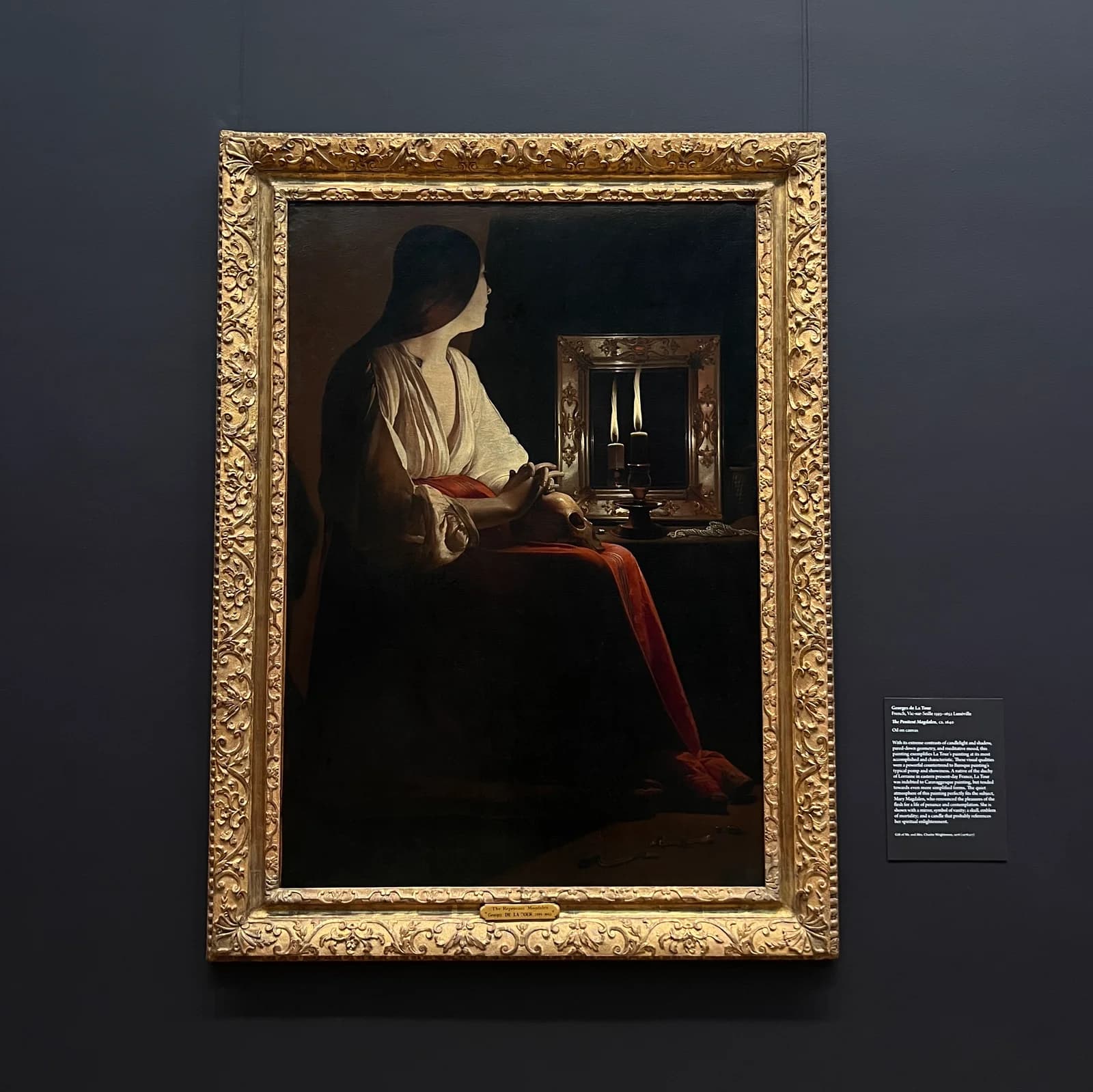
The painting depicts Magdalene in steadfast contemplation. We see her with her pearls stripped away, hands folded atop a human skull, and the ephemeral candle reflecting itself in the mirror. Popular art history analysis interprets the pearls and mirror as earthly vanity, the candle as spiritual enlightenment, and the skull as a nod to mortality.
What I find most captivating about this painting is that Magdalene herself is not the subject of the composition; rather, her contemplation is. Her gaze is turned away from the viewer, and what we gain instead is a clandestine window into Magdalene at a moment when she seems to be interrogating the values prescribed to her, and disaggregating them from what she wants for herself. In this suspended frame, with her earthly possessions peeled away, she’s come face-to-face with her own self-actualization.
Mary Magdalene is a particularly apt subject for this depiction. At the time of this painting, she was one of the most popular saints in Catholic Europe, serving as an emblem of repentance and sacrament. Interestingly, early Christian writing — such as the Gospel of Mary — depicted Mary Magdalene as a reverent apostle. But over time, she was narrowed and conflated with an unnamed “sinful woman” in the Gospel of Luke, consequently compounding into a caricature of a model repentant sinner. Some hailed her as a shameful prostitute, others named her Jesus’s right hand; but in every world, she was defined by someone else’s interpretation instead of her own.
The painting captures a moment of transition in Magdalene’s life, and it found me during a transition of my own as I was settling into a new chapter in New York. Like Magdalene, I had been challenging myself to think more critically about a life that was honest and innate, affording myself exemption from external values and expectations. In this liminal space, I was with her. And in return, she visited me often in my September dreams.
In her hermetic room, I wonder how she feels about her image being misconstructed and misinterpreted over centuries. I wonder if she wants to do anything about it. I do not know her, yet she made my gaze tender and curious. Sometimes, I think I was her.
I saw Magdalene through my own Asian American lens, and reflected on how my upbringing shaped my relationship to external perception. In that, I learned to fear it. In that, a holistic expression of self could feel like it would jeopardize an appearance of conformity and perhaps, even lovability. I used to believe I was absolved from this tension, but it’s unreasonable to think I’m yet fully sanctified.
What happens when external markers of what other people think of you become your pinnacle criterion, rather than internal intuition?
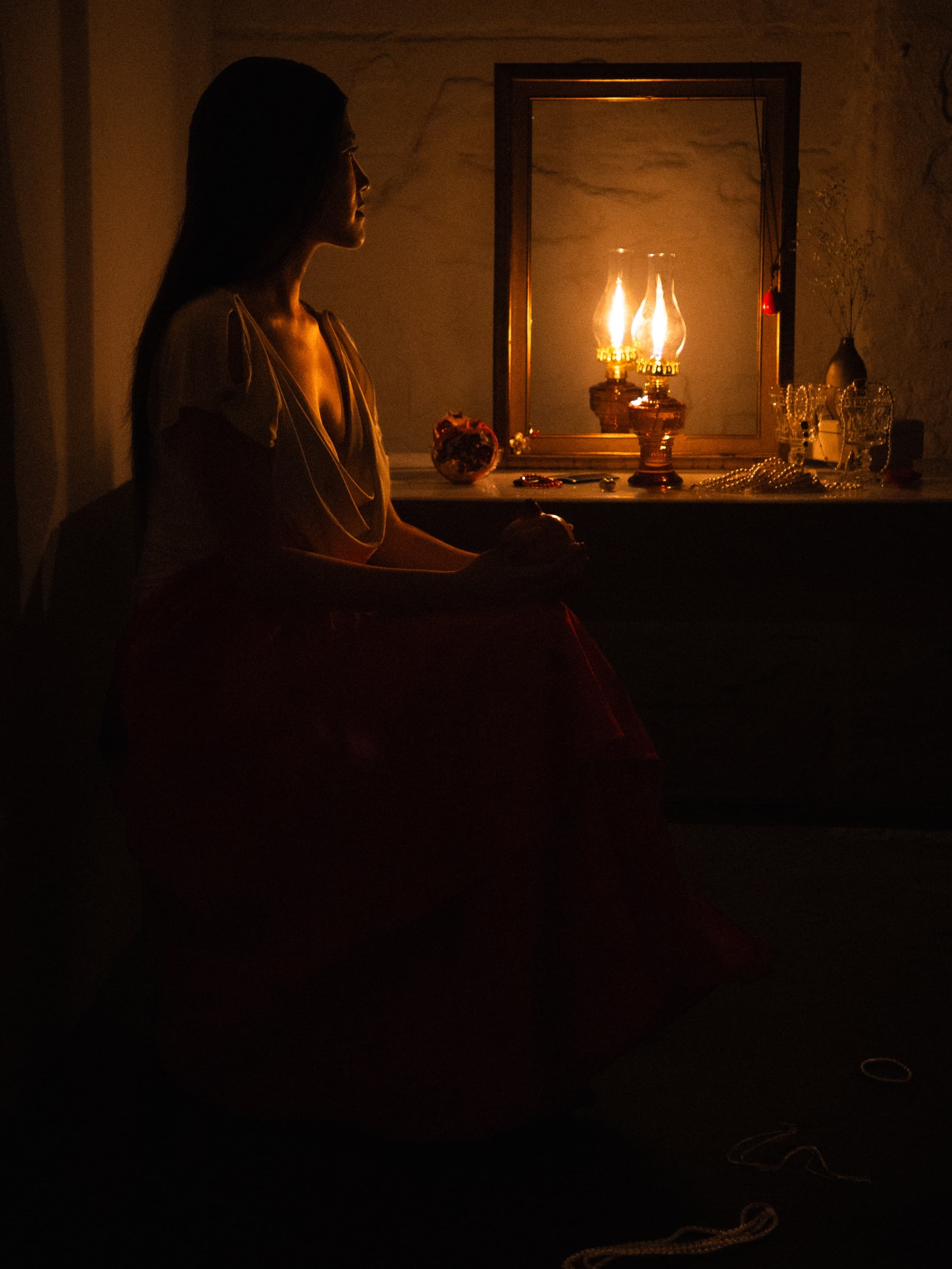
I don’t have a definitive answer, but I did have a curiosity to reframe what Magdalene’s contemplation looks like. I wanted Asianness sitting at the precipice of change, and I wanted it to be from the lust for life rather than from the fear of death. I swapped Magdalene’s skull motif for pomegranates, entangled Chinese red on the table in the form of precious objects, and created an image sequence that patiently moves the audience from distant witness to intimate confidant.
At this precipice, I wholly believe in Magdalene’s courage to break open collective expectations and reach for earnest risk — a life of her own.


 back to writings